2nd Semester Starts on 1/22/26.
Updates:
-How did 1st semester go? Grades are due on 1/30. Please review your MNCA HS Transcript and make a plan if needed.
-Have you looked at your courses for 2nd semester?
We are quickly approaching the end of first semester and starting to prepare for the second half of the school year. The current semester deadline is 10pm on Friday, January 16th. The second semester will begin on Thursday, January 22nd. In an effort to have a smooth start to the new semester, please review your assigned courses TODAY! This will help ensure that everyone is in the correct classes. Please follow the steps below and reach out to YOUR SCHOOL COUNSELOR if something doesn't look right to you. Doing this now, before the new semester begins, will make things easier for you and the school counseling team.
1. From your Student Homepage
2. Click on the Links section
3. Click on Course Placement Tool
4. Click on MNCA
5. The 2025-26 assigned courses will show up on the right side. Review the classes listed for second semester.
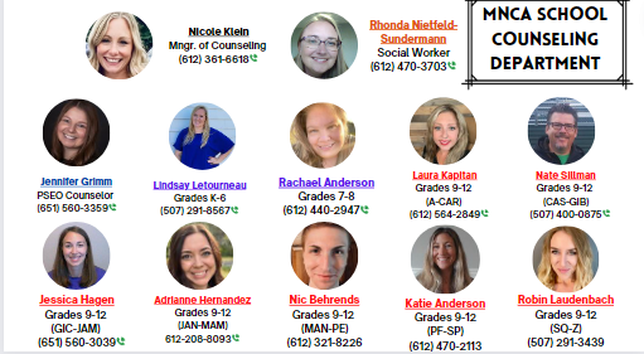
6. Send a webmail to your school counselor from THIS list if you feel something is incorrect
--------------------------------------------------------------------------------------------------------------------------------------
Community Events (not hosted or sponsored by MNCA)
High School Reminders:
Success Sessions will be held every Wednesday based on grade-level. We can't wait to see you there!
Live Lesson Schedule
Course Changes: You have 4 weeks after the start of the semester to make any course changes.
-->Course Guide
Success Sessions will be held every Wednesday based on grade-level. We can't wait to see you there!
Live Lesson Schedule
Course Changes: You have 4 weeks after the start of the semester to make any course changes.
-->Course Guide
Minnesota Association for Children's Mental Health Tips for Supporting your Child About Recent Events:
1) Communicate Appropriately: Evaluate what is appropriate to share with your child about recent events. It's important they know even when things feel big and scary, it is safe for them to talk to you.
2) Listen Actively: Your child may have a lot to say, or very little, but it's important that you give them your undivided attention and support them as they process their thoughts and feelings out loud.
3) Remain Calm: This is scary for adults, too. Remember to remain calm as best you can, when having a conversation with a child. Your calmness will help them feel more secure.
4) Turn Off the Media: Though it's helpful for adults to stay informed, overconsumption of the media around an event can cause further distress for children.
5) Monitor for Changes in Behavior: Tragedy and trauma can activate a number of emotions for children. Monitor their behavior for any short and long term changes that may require additional mental health support.
Supporting Kids Impacted by Violence
If you or a loved one is experiencing a mental health crisis, call or text 988.
---------------
How to talk to your children about difficult news
How to talk with kids about tragedies and other traumatic news events
Helping children and adolescents cope with traumatic events
Traumatic separation and immigration and refugee children: Tips for caregivers
1) Communicate Appropriately: Evaluate what is appropriate to share with your child about recent events. It's important they know even when things feel big and scary, it is safe for them to talk to you.
2) Listen Actively: Your child may have a lot to say, or very little, but it's important that you give them your undivided attention and support them as they process their thoughts and feelings out loud.
3) Remain Calm: This is scary for adults, too. Remember to remain calm as best you can, when having a conversation with a child. Your calmness will help them feel more secure.
4) Turn Off the Media: Though it's helpful for adults to stay informed, overconsumption of the media around an event can cause further distress for children.
5) Monitor for Changes in Behavior: Tragedy and trauma can activate a number of emotions for children. Monitor their behavior for any short and long term changes that may require additional mental health support.
Supporting Kids Impacted by Violence
If you or a loved one is experiencing a mental health crisis, call or text 988.
---------------
How to talk to your children about difficult news
How to talk with kids about tragedies and other traumatic news events
Helping children and adolescents cope with traumatic events
Traumatic separation and immigration and refugee children: Tips for caregivers
Remember to STRETCH:
S: Prioritize your safety
T: Treat yourself
R: Rest & Relax
E: Exercise *Movement*
T: Talk to Someone
C: Care for self- and others
H: Hold on to hope
(Adapted from Hatchingresults.com)
Counseling at MNCA
Who do I contact?
Counselors
Contact Information for your team is found when you login to your Pearson Online Classroom homepage. You can call/text/webmail all staff directly.
Counselors
- Course Changes
- Graduation Plans
- Mental Health Support
- Academic Support
- Resources
- Academic plans for the semester
- Sports participation
- Release to other school's functions
- Revisions
- Content Support (resources/one-on-one)
Contact Information for your team is found when you login to your Pearson Online Classroom homepage. You can call/text/webmail all staff directly.
What does my Counselor do?
The role of a counselor is to help all students:
Apply academic achievement strategies
Manage emotions and apply interpersonal skills
Plan for postsecondary options (higher education, military, workforce, etc.)
and more!
Apply academic achievement strategies
Manage emotions and apply interpersonal skills
Plan for postsecondary options (higher education, military, workforce, etc.)
and more!
We can't promise to fix all of your problems, but we do promise that you will not have to face them alone."
Your School Counselors are Here for You!